Elkhart Brass Launches New Electric Xtender
Elkhart Brass has introduced the Electric Xtender, a motorized deck gun extension that deploys in 10 seconds, raises 18 inches above the pump panel, and can flow water in both the raised and lowered positions. Here is what that adds up to in practical terms.
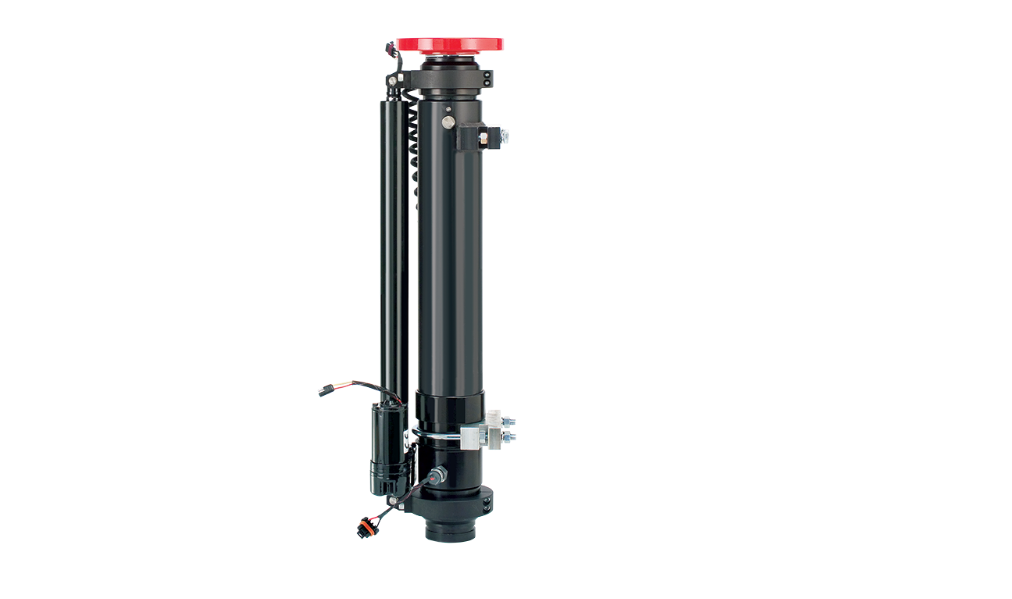
What the product does
The Electric Xtender (Elkhart Brass model 8598) is designed to give crews a powered way to raise a deck gun above the pump house without manual effort and without interrupting water flow. The 18-inch gain in elevation can meaningfully improve stream trajectory and reach, particularly on defensive attacks or exposure protection where angle matters. The fact that it flows in both positions means operators are not forced to choose between repositioning the monitor and maintaining a working line.
A few published specs worth having in front of you: it deploys in about 10 seconds, the actuator is rated for a static load up to roughly 2,500 lbs, it runs on 12 or 24 volts, and it's rated for flows up to 1,250 gpm at 100 psi nozzle pressure. It also includes an in-cab warning light for incomplete retraction and a pressure switch that limits movement once internal pressure climbs past about 10 psi — both sensible touches for keeping a powered component from moving under load.
How it compares to a conventional fixed monitor
Most departments running a conventional deck gun or fixed monitor today are working with a manually positioned device that sits at a fixed height above the apparatus. Raising a standard monitor typically means stopping flow, making a physical adjustment, and re-establishing the stream — a process that takes time and puts a firefighter at the pump panel during active operations.
An 18-inch powered extension addresses a few things that apparatus committees genuinely weigh: Capability.
A higher discharge point improves downward stream angle into a structure or over an intervening obstruction. That is not new physics, but getting there in 10 seconds without interrupting flow is a real operational difference from a static mount.
Training burden.
Because the device operates in both positions, crews do not have to learn a different flow procedure for the raised versus lowered state. That lowers the cognitive load at a working fire.
Maintenance.
Any time you add electric actuation to a component that lives on the outside of a pumper, you are adding a motor, wiring, and connectors to your PM checklist. That is a fair trade-off for many departments, but it is worth building into your apparatus maintenance schedule from day one rather than discovering it at a 3 a.m. call.
Lead time and retrofit potential. It's worth confirming directly with Elkhart Brass whether this is a factory-order option, a retrofit, or both, and what the lead-time impact looks like, before you spec your next apparatus or plan a midlife refresh.
What else is already on the market
Here's the part the product announcement won't tell you: powered and extending risers are not a new category. If you're evaluating the Electric Xtender, you should be cross-shopping it against the devices already in the field, because the "raise the monitor above the pump house" problem has been getting solved several ways for years.
Task Force Tips Extend-A-Gun (the closest head-to-head).
TFT's Extend-A-Gun series is the most direct competitor. It extends a monitor either 12 or 18 inches above the pump housing, and — this is the key point — it's offered in manual, pneumatic, and remote-controlled (electric) versions. The remote-controlled 18-inch version goes toe-to-toe with the Electric Xtender on the headline feature: powered actuation at the same 18-inch lift. It's a mature, widely deployed product line built from hardcoat anodized aluminum with a five-year warranty. For ballpark budgeting, the manual 18-inch version lists in the low-$2,000s while the remote-controlled version runs into the low-to-mid $6,000s — exact pricing varies by configuration and dealer, so verify before you quote it to a committee.
Akron Brass Electric Riser.
Akron's powered option pairs with their DeckMaster and StreamMaster monitors. It's electrically actuated (12 or 24 volt) with a manual override, a five-year warranty, and a compact three-piece design that nests down to around 18.5 inches for tight pump modules. The notable difference: it provides 12 inches of extension, not 18. If maximum elevation is the goal, the Xtender has the edge; if pump-house clearance is the constraint, Akron's compact nesting is a point in its favor.
Manual pull-pin and telescoping options. Several products reach the same height — or higher — without any electric actuation at all:
Akron Apollo Hi-Riser — pull a pin and the discharge raises a full 24 inches above the deck, and it converts to a portable ground monitor. No power, no PM motor, but it's a hands-on adjustment.
TFT Radius — a deck-mounted monitor that elevates roughly two feet by pulling a quick-release knob, and it can flow while stowed.
TFT manual Extend-A-Gun and Elkhart's own fixed extensions (such as "The Pipe") — straightforward telescoping or fixed risers in the 16–18 inch range, at a fraction of the cost of any powered unit.
The honest takeaway: the Electric Xtender's three headline features — powered actuation, 18 inches of lift, and flow in both positions — are all genuinely useful, but none of them is unique to this product. TFT's remote Extend-A-Gun matches the powered-plus-18-inch combination, and several manual devices reach the same height or higher for well under half the cost. Where the Xtender earns its place is integration with Elkhart's monitor ecosystem and the specifics of its control and safety package. That's a real consideration if you're already an Elkhart house — but it's a reason to spec it, not an argument that nothing else does the job.