Designing Your Next Tender for Your Fireground
Here I explain how effective water tender design is driven by how a fire department actually operates, not just by maximizing features or tank size. It emphasizes that while all tenders serve the same core purpose—moving water—the best trucks are flexible, reliable, and tailored to real-world use, whether that’s drop tank operations, engine nursing, or wildland support.
In my role, one of the things I do more than anything else is work with departments to create trucks that solve as many problems as possible. While the trucks themselves may vary significantly, the solutions they represent are often very similar. At the end of the day, all tenders do one thing — and that is move water. Anything beyond that is icing on the cake.
One of the first questions I ask departments is, "How do you use the truck you have now?" It's a great question, and it helps me understand what features will integrate well with how a department currently utilizes their tenders. The majority of departments use drop tanks as standard practice in their rural water supply operations, while many almost exclusively nurse their engines from the tender.
Obviously, the circumstances of a scene will dictate the most effective way to supply water. A long, steep driveway may force a department to lay down a supply line even if that is not the typical practice. The best tenders are the ones that don't lock you into a single approach.
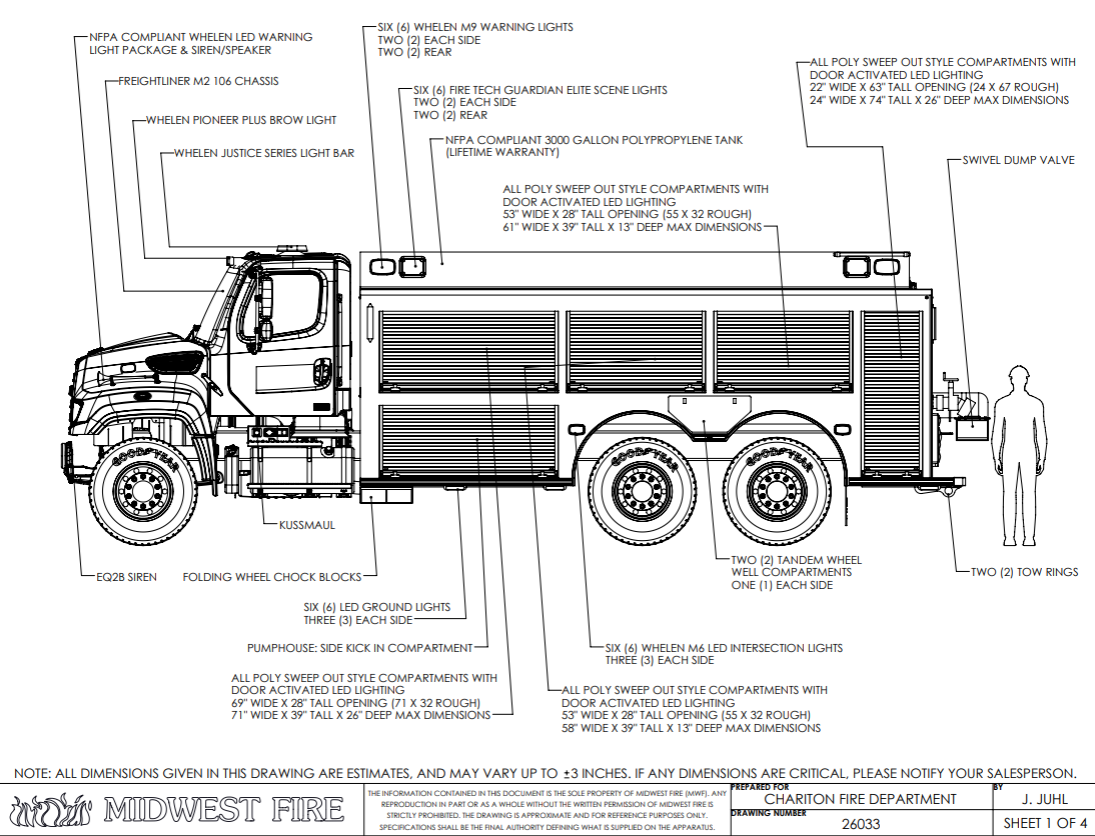
Using the truck in my picture as an example — this truck was spec'd to meet a handful of needs. Replacing an aging unit was priority number one. After that was an increase in water capacity and the ability to carry much-needed wildland equipment to the scene. As a department that runs a high volume of wildland calls, they needed a truck that could feed their fleet of brush trucks and UTVs, as well as carry all the extra hand and power tools. We also took advantage of the opportunity to upgrade from a portable engine-driven pump to a small (500 GPM) PTO pump — this will reduce maintenance as well as increase capability.
That last decision is a good example of how small spec choices add up. A PTO pump is always there, always ready, and doesn't require a firefighter to pull-start a portable in the middle of a working incident. For a department running brush trucks off the tender, that kind of reliability matters.
Sizing the tank
Water capacity is the first place most conversations go, and for good reason. But bigger isn't always better. A 4,000-gallon tank on the wrong chassis will give you a truck that's slow getting to the scene, hard on roads, and a handful in the driveway. I usually push departments to think about water capacity in the context of their actual response area — how far is the nearest fill site, how long does it take to dump and turn the truck around, and how many trucks are in the rotation. A 2,000-gallon truck that can shuttle three loads in the time a 3,000-gallon truck makes two is the better tool — and it's usually cheaper to spec and maintain.
Dumping and filling
How water gets off the truck matters as much as how much water is on it. Most departments are running some combination of side and rear dumps. A good rear direct fill, a top fill and tank to pump let your tender refill from just about any source you'll encounter.
I'd also encourage departments to think about discharge piping early. If you're nursing engines, a 2.5" front discharge with a pre-connect can save real time on scene. If you're running drop tank operations, dump valve placement and control location are what will make the truck feel fast — or feel clumsy.
Compartmentation and crew
Once water and pump are figured out, the rest of the truck is about what you carry and who you carry. A department running wildland may need different compartmentation than a department whose tender is strictly water-only. Two-door vs. four-door cabs, commercial vs. custom chassis, and whether you need walk-around compartments are all decisions that should be tied back to how the truck will actually be used.
Build it for the way you fight fire
The best tender is the one that fits how your department operates today and gives you room for how you might operate five years from now. Talk to your crews. Look honestly at your call volume and your water supply. Visit a department that runs a truck similar to what you're considering and ask them what they'd change. The truck you spec is the truck you're going to run for the next 30 years — it's worth getting right.
If you're starting to think about your next tender and want a sounding board, I'm always happy to talk through options.